

College of Teacher Education, Ningbo University Holds Academic Seminar and Farewell Ceremony for Professor Limin Jao from McGill University’s Faculty of Education
 May 19, 2026


From May 7 to 18, Professor Limin Jao from McGill University, Canada, visited the College of Teacher Education, Ningbo University, at our invitation for a two‑week academic exchange. During her visit, she delivered five insightful lectures as part of the “Fenghua Scholars Young Scholars Forum” (Sessions 5, 6, 7, 8, and 9), covering topics such as student‑led inquiry projects in Canadian classrooms, the art of academic writing and international journal publication, the sustainable balance of an academic career, and doctoral students’ longitudinal data tracking research. She candidly shared her reflections on burnout, self‑care, and embracing imperfection, inspiring faculty and students to rethink the growth pathways of scholars and educators. In addition, Professor Jao visited Weidou Primary School and Dongfeng Primary School in Beilun District, where she observed “same content, different teaching designs” mathematics lessons and vibrant student activities, building a bridge for Sino‑Canadian educational practice and fostering cross‑cultural dialogue with local teachers.
On the morning of May 18, faculty members from the College of Teacher Education engaged in in‑depth discussions with Professor Jao on core topics including teacher education, curriculum and instruction, digital media applications, AI‑integrated teaching, and models for international cooperation. Professor Jao introduced her research priorities in mathematics education, STEM education, and teacher professional development, with particular attention to the articulation between pre‑service teacher training at the university level and in‑service teacher practice in schools. Chinese scholars, drawing on local practices, raised a series of key issues: fostering students’ problem‑awareness skills in the context of new textbooks, educational assessment reform (e.g., incorporating affective performance into evaluations), AI integration in teaching (application rules, balancing aesthetic education, and enhancing teachers’ digital literacy), developing English teaching competencies for non‑English‑major pre‑service teachers, and the impact of digital media on adolescent development.
Both sides exchanged insights on teacher education systems and the differences between Chinese and Canadian classroom models. The Canadian side shared the structure of McGill’s Faculty of Education and its research strengths in second language education, sociology of education, and other fields; the Chinese side outlined the characteristics of China’s normal education system. Regarding cooperative models, both parties reached a consensus: short‑term collaboration could include online lectures, medium‑term plans could involve summer schools and workshops, and long‑term goals would cover joint research, faculty and student exchanges, and curriculum co‑development. They also exchanged views on common challenges such as teacher burnout and insufficient school‑university linkages, agreeing that bridging the theory‑practice gap requires strengthening practicum, internships, and collaborative research.
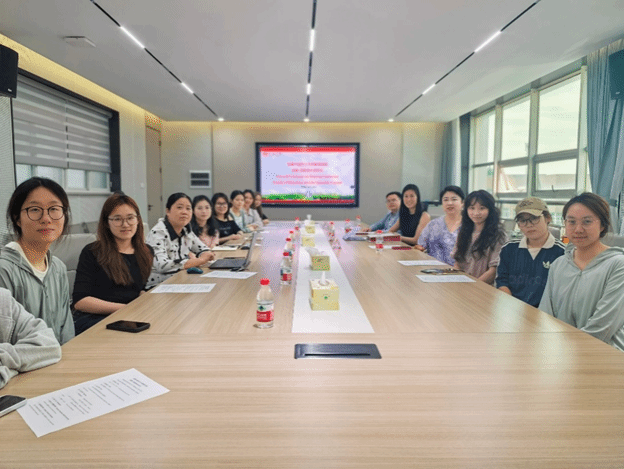
At 15:00 on the afternoon of May 18, the College held a farewell ceremony for Professor Jao in Room 413. In his speech of appreciation, Yu Lichuan, Deputy Leader of the College’s Internationalization Leadership Group, noted that Professor Jao’s profound insights during this visit had sown promising seeds for future collaboration in joint research, student supervision, and faculty exchanges. He expressed the hope for continued and deepened partnership in student development and teacher training, and affirmed that the College would spare no effort in furthering cooperation with McGill’s Faculty of Education. At the conclusion of the ceremony, the College extended its sincere best wishes to Professor Jao. Professor Jao expressed her gratitude to Ningbo University for its warm hospitality, saying that her visit to China had been unforgettable, and she looked forward to maintaining close ties and jointly advancing educational exchange and cooperation in the future.
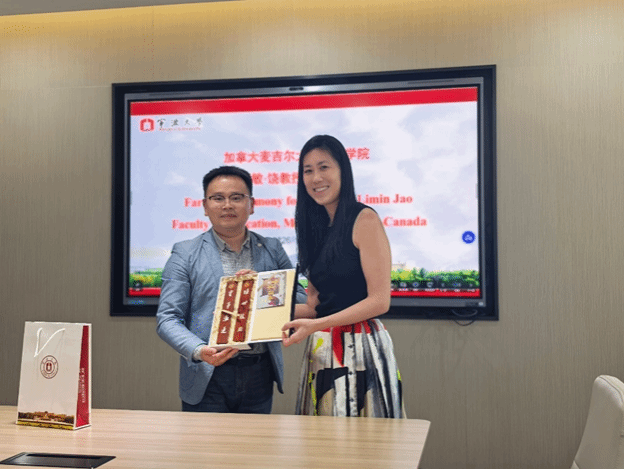
This visit and the associated seminars were not only a meeting of minds but also an empowerment for collaboration. Both sides agreed to take this event as an opportunity to continue promoting academic mutual learning, faculty‑student exchanges, and joint projects, and to work together to explore new pathways for educational internationalisation, thereby supporting the high‑quality development of our College’s international endeavours.
【Close 】



