

Making Ningbo University's Voice Heard on the International Academic Stage, Sparking New Thinking on Cutting-Edge Marketing Issues!
 Jun 23, 2026


Our Students Participate in the 4th Annual Conference of the Asia-Pacific Marketing Academy (APMA) 2026
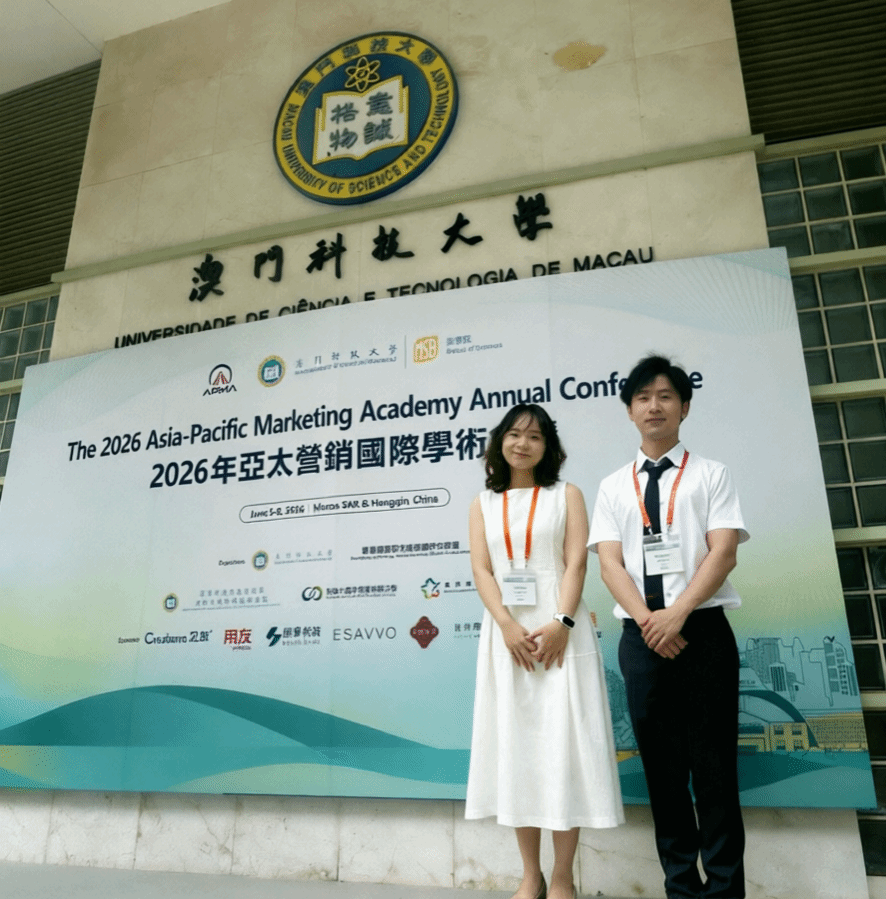
In line with Ningbo University's strategy of building a "high-level university" and the internationalisation development strategy of the College of Teacher Education, from June 5 to 8, 2026, the 4th Annual Conference of the Asia-Pacific Marketing Academy (APMA), hosted by the Guangdong-Hong Kong-Macao University Marketing Research Alliance and organised by the School of Business at Macau University of Science and Technology, was successfully held under the "one conference, two venues" model in the Macao Special Administrative Region and the Guangdong-Macao In-Depth Cooperation Zone in Hengqin. Two postgraduate students from our College, Cao Xuan (Class of 2024) and Lu Mengcong (Class of 2025), were invited to attend and present their academic papers, engaging in exchanges and learning alongside over 500 scholars from 15 countries and regions, including China, the United States, the United Kingdom, Australia, Japan, Canada, France, Italy, New Zealand, Singapore, India, and the United Arab Emirates. Their participation fully demonstrated the latest progress of our College in research areas such as consumer psychology and consumer behaviour.
Themed "AI-Driven Market Collaboration and Marketing Innovation," the conference focused on cutting-edge issues at the intersection of artificial intelligence and marketing science. Our participating team, guided by the philosophy of "promoting teaching through research and enhancing academic thinking through an international perspective," presented high-quality academic papers and engaged in lively on-site interactions, vividly illustrating the College's commitment to the practical pathway of "cultivating top-notch innovative talents with a global vision."
Decoding the Persuasive Power of Nostalgic Advertising
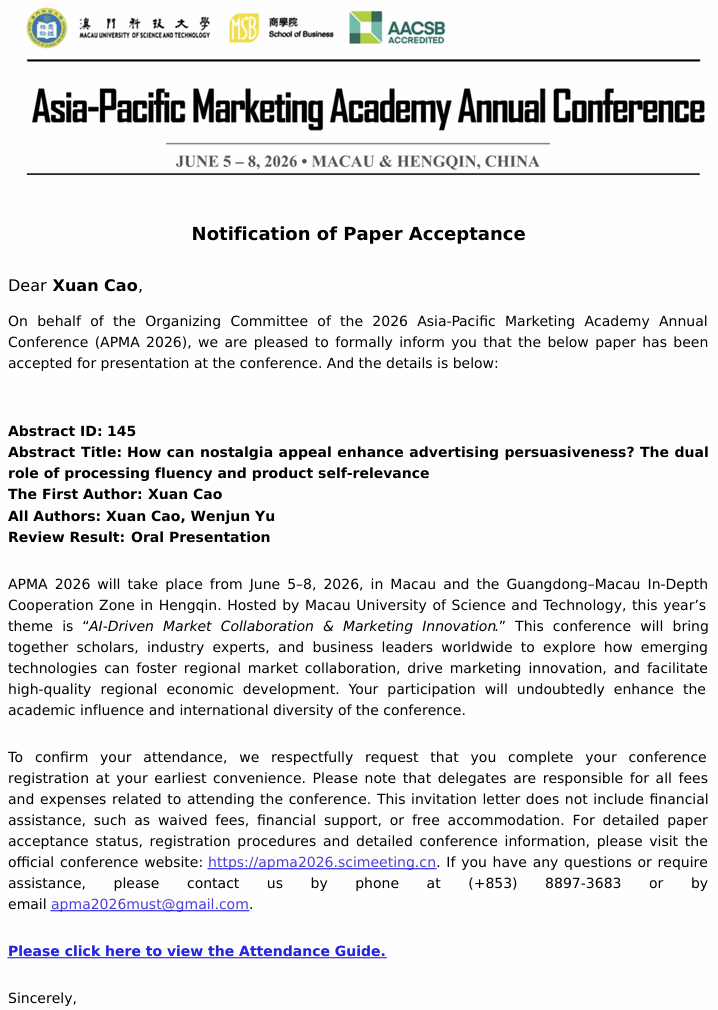
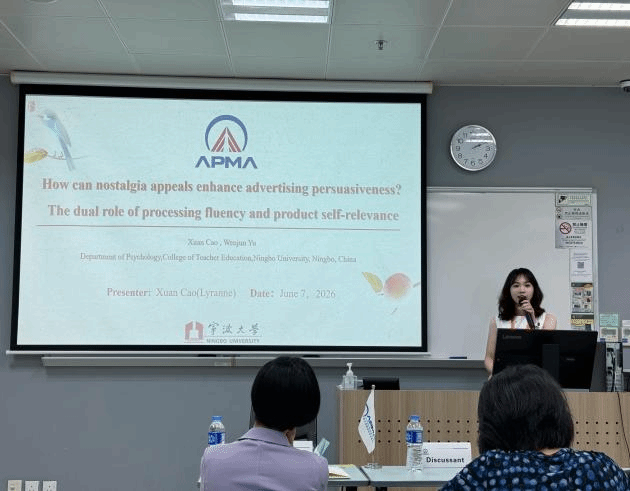
In session D2A6 "Consumer Behavior," first-year Master's student Cao Xuan presented a paper titled "How can Nostalgia Appeal Enhance Advertising Persuasiveness? The Dual Role of Processing Fluency and Product Self-Relevance," co-authored with her supervisor, Associate Professor Yu Wenjun. The study, grounded in cognitive processing theory, explored the impact of nostalgic appeals on consumer attitudes in modern advertising and marketing, revealing the internal cognitive mechanisms through which nostalgic advertising appeals influence consumers. The findings provide practical insights for enterprises to optimise advertising creativity and develop differentiated marketing strategies. The results indicate that nostalgic advertising enhances persuasiveness through processing fluency; product self-relevance is closely related to nostalgic advertising appeals; and product type serves as a boundary condition for this effect. The study reveals that in the contemporary marketing context, nostalgia can reactivate consumers' intrinsic psychological mechanisms and build emotional connections. It also examines the applicability of different product types in various consumption scenarios, offering important guidance for enterprises in formulating, selecting, and designing nostalgic advertising strategies, with significant practical value for market applications.
The Value Hidden in Traditional Chinese Colour Naming
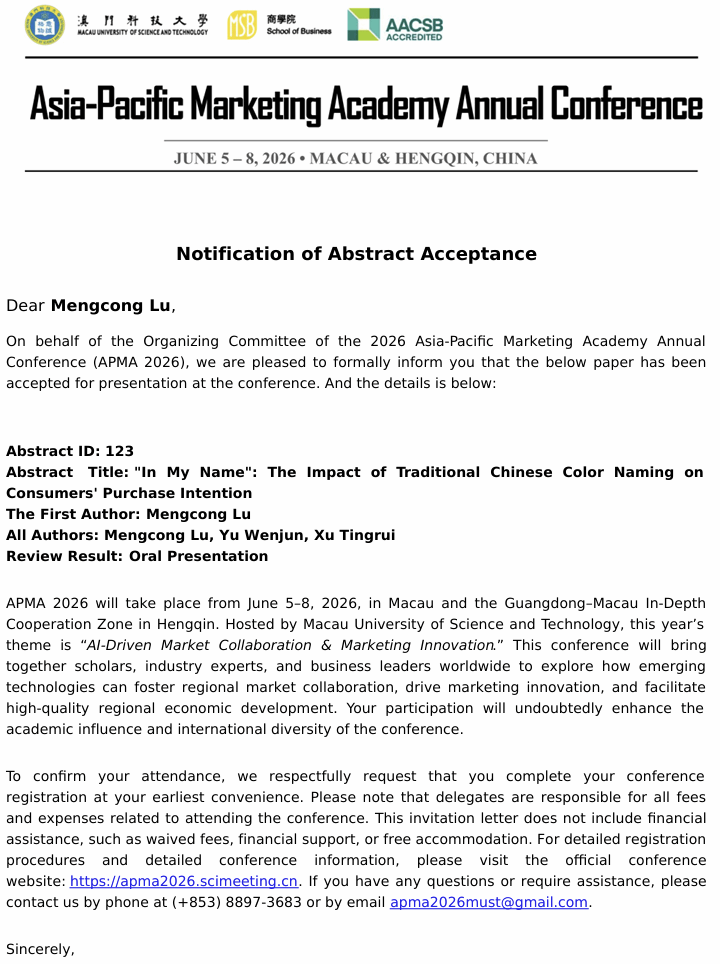
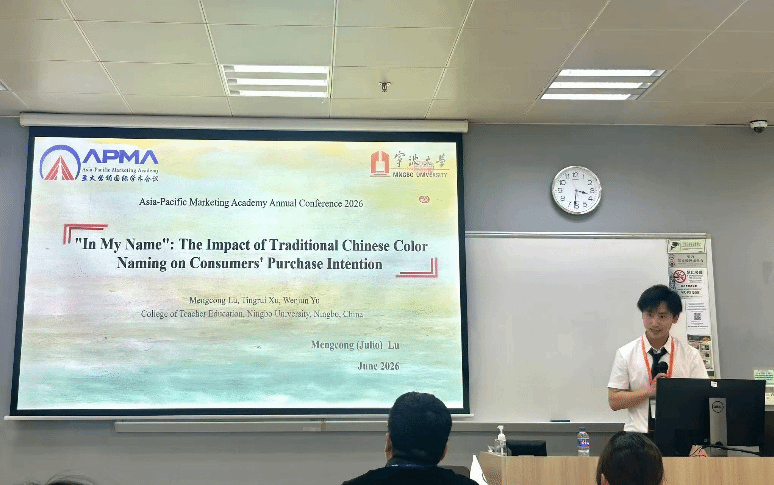
In session D2B8 "Consumer Behavior," second-year Master's student Lu Mengcong presented a paper titled " 'In My Name': The Impact of Traditional Chinese Color Naming on Consumers' Purchase Intention," also co-authored with her supervisor, Associate Professor Yu Wenjun. Set against the backdrop of China's cultural revitalisation strategy and the rise of "guochao" (national trend) consumption, the study focused on the marketing strategy of naming products using traditional Chinese colours, aiming to investigate its impact on consumer preferences and purchase intentions. The research identified the advantage effect of traditional Chinese colour naming and explored its mediating psychological mechanisms and boundary conditions. This study reveals the persuasive pathways and cultural empowerment mechanisms of traditional colour naming in online consumption contexts, providing theoretical foundations and strategic references for brands' cultural marketing practices in the digital environment, and helping to achieve a deep integration of cultural heritage and commercial value.
Student Voices: Dialogue with Global Researchers on the International Academic Stage
Cao Xuan shared her reflections after the conference: " 'Going global' is a powerful goal and conviction. I am very grateful for the guidance and trust of my supervisor, and for the support and assistance provided by our College, which made it possible for me to 'go global' with my paper and share and exchange ideas with teachers and students from around the world. On this cross-cultural and even cross-disciplinary exchange platform, we witnessed many academic ideas materialising, experienced the collision of different perspectives, and learned about the current developments in many related industries. During this process, we exchanged opinions and ideas and also received much encouragement. This 'going global' experience has greatly inspired me. I believe we should maintain an open and exploratory spirit—being rigorous and conscientious in our academic work while advancing our thoughts and steps forward. In the future, whether in academia or in life, the power of 'going global' will give me more confidence and courage to face challenges and push beyond my limits. I also hope that our university, our College, and all of us can find broader horizons to explore, to learn, and to grow!"
Lu Mengcong remarked after the conference: "As a first-year Master's student attending an international conference for the first time, this APMA annual meeting was truly an unforgettable experience. Standing on an international podium to present my own research was both nerve-wracking and exciting, but what was even more precious was attending presentations across different sessions and engaging in face-to-face exchanges with top scholars, which gave me a genuine sense of the vitality of the academic community. Even though it was only a few days, every question and discussion opened up new perspectives on consumer psychology research. I am especially grateful to the university and the College for providing this valuable platform, and I sincerely thank all the teachers for their meticulous guidance during the preparatory phase. This experience has shown me where I need to improve and has reinforced my determination to move forward. In the future, I will treasure every learning opportunity and take solid steps throughout my Master's journey."
College Direction: Deepening International Cooperation and Enhancing Global Competence of Faculty and Students
The College of Teacher Education has always regarded internationalisation as a core engine for postgraduate education, adhering to the educational philosophy of "empowering faculty and students to make their voices heard on the international academic stage." This conference participation not only showcased the latest research achievements of our College in the fields of consumer psychology and behaviour, but also marked our firm commitment to integrating into the global marketing academic community. The Asia-Pacific Marketing Academy (APMA) annual conference, jointly initiated by universities in Guangdong, Hong Kong, and Macao, has rapidly become an important academic platform in the region despite its relatively recent establishment. This participation was not only a vivid demonstration of the College's research outputs reaching the global stage, but also provided a growth platform for postgraduate students to directly engage with cutting-edge academic frontiers and hone their cross-cultural communication skills, significantly enhancing the international visibility of our research. It represents an important milestone in deepening postgraduate education reform and fostering a high-level academic ecosystem within the College.
Looking ahead, the College will continue to expand its international cooperation networks, supporting faculty members to pursue overseas visits and joint research, and encouraging students to participate in international conferences, dual-degree programmes, and joint training initiatives. Through systematic institutional support and sustained resource investment, the College aims to regularise high-level academic exchanges, help faculty and students enhance their influence and voice in the global academic landscape, and drive a comprehensive leap in the quality of postgraduate education.
【Close 】



